Note
TODO: Write about secondary legislation.
Private Members bills are pushed by backbenchers, rather than the government. There are very few of these with only a 5% chance that one becomes law.
This is because the government has support for their own laws, whereas a random backbencher does not.
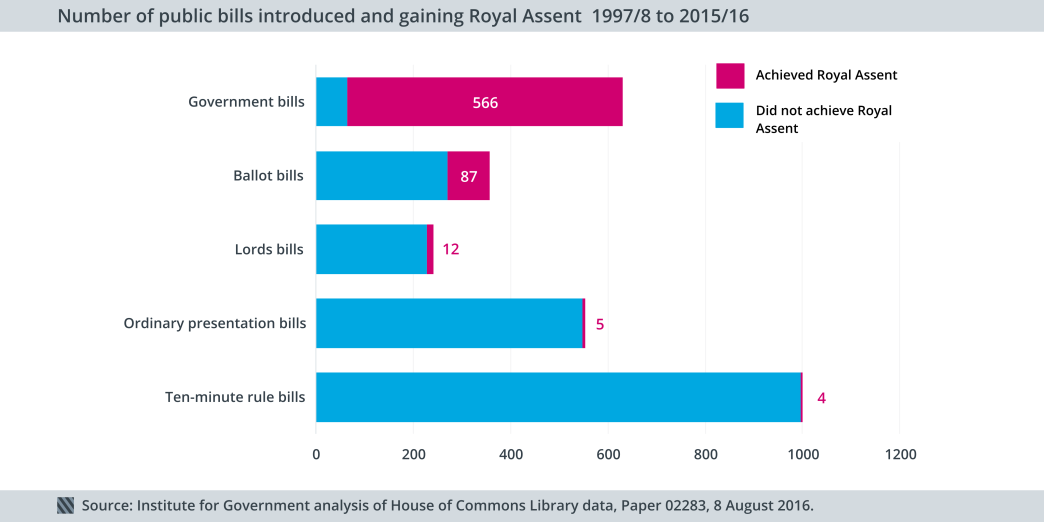
Private members bills are public bills introduced by MPs or peers who are not government ministers with the purpose of changing the law for the general population. Through law become law, they provide a way for backbenchers to raise issues not on the government’s agenda and can influence legislation through publicity.
- Ballot Bills: at the start of a parliamentary session, a ballot is held and the 20 MPs whose names that are drawn get priority time to debate their bill. These bills have the chance of becoming law. These are the most common and often introduce something new.
- Ten Minute Rule Bills: an MP can get a 10-minutte slot to speak about their bills after Question Time.
- Presentation Bills: the bills title is read out in the House of Commons but no speech is given.
Legislation
%% … Every year there is a … %%
Note
TODO: Write up. Ballots?
Examples
Abortion Act 1967
- Legalised abortion for the first time in the UK.
- Made abortion lawful up to the 28th week of pregnancy (later reduced in subsequent amendments, i.e., 1990 - 28 reduced to 24).
- Introduced by David Steel, who came 3rd in the Private Member’s Bill ballot.
Terminally Ill Adults (End of Life) Bill
Info
This bill is still in progress! View here
- Would allow terminally ill adults with a prognosis of six months or fewer to request medical assistance to end their life.
- Requires approval from two independent doctors.
- Proposes safeguards such as mental capacity assessments and voluntary, informed consent.
Sexual Offences Act 1967
- Decriminalised homosexual sexual intercourse between two men over the age of 21 in private (England & Wales).
- Introduced by Leo Abse in the Commons and Lord Arran in the Lords.
- Marked a shift toward more liberal attitudes on social issues during the 1960s.