Asymmetrical Devolution
Asymmetrical devolution where the powers of devolution are unbalanced, with powers being inequal.
Changes
Legislative - law. Fiscal - money.
Scottish
Progress
Scotland Act 1998 (Inception)
Established the Scottish Parliament and Executive. Followed a “Reserved Powers” model (exemptions). Holyrood can legislate on anything not specifically reserved for Westminster (e.g., health, education).
Scotland Act 2012
Granted the power to set a Scottish rate of Income Tax (up to 10p for every pound) and devolved Land and Buildings Transaction Tax.
Scottish Independence Referendum 2014
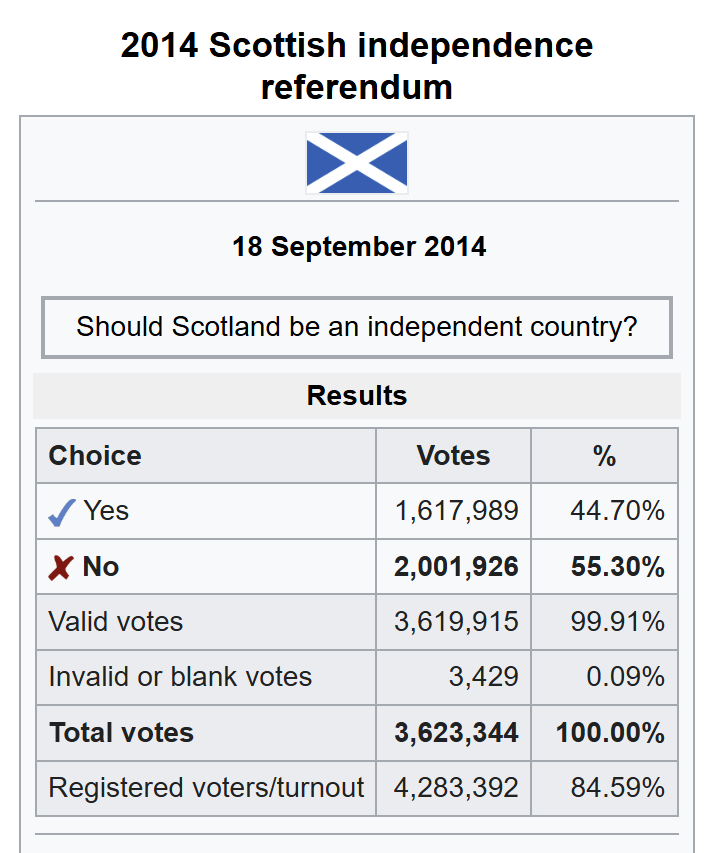
See Devolution Begins!.
Scotland 2016
Post-2014 referendum reform. Devolved full control over Income Tax bands/rates, significant welfare powers (e.g., Personal Independence Payments), and established the Parliament as a part of the UK constitution.
Scotland since 2014
After the Brexit referendum, the SNP pushed for a second Scottish Independence referendum in 2017. This was because of the shear difference between the Scotland EU vote and the UK EU vote, but also due to political opportunity.
Exam points
- Policy divergence
- Free University
- Different tax system
Wales
Progress
Government of Wales 1998
Created the National Assembly for Wales. It only had “Executive” powers (the power to implement laws) but no primary law-making powers.
Government of Wales 2006
Separated the Legislature from the Executive. Allowed the Assembly to gain law-making powers on a case-by-case basis.
Wales Act 2017
Moved Wales to the “Reserved Powers” model (matching Scotland). Renamed the Assembly to Senedd Cymru (Welsh Parliament) and devolved some tax-raising powers.
Upcoming Voting Changes 2026 (May)
From the May 2026 election, Wales has replaced its old AMS system with a ‘Closed List Proportional System’ for Senedd elections.
- Each voter has one vote only/you vote for a political party or an independent candidate.
- Parties provide a “closed list” of candidates in a fixed order. You cannot choose between individuals if a party has two seats in your area, the top two people on their pre-set list are elected.
- Wales is now divided into 16 constituencies (created by pairing the 32 Westminster seats). Each constituency elects 6 Members of the Senedd (MSs).
- Members increased from 60 to 96 MSs to provide more scrutiny of the Senedd.
- Anyone over the age of 16 can vote in Senedd elections.
Since 1998, the Welsh Labour party has been in power with strong votes. It is likely that the next election is going to change control to either Plaid Cymru or Reform.
Exam points
- Plastic bag charge
- Opt-out organ donation
Northern Ireland
Progress
Northern Ireland Act 1998
Result of the Belfast (Good Friday) agreement. Established the Assembly and Executive based on mandatory cross-community power-sharing (Unionists and Nationalists).
Northern Ireland Act 2006
Reformed how the First and deputy First Ministers are appointed to ensure the two largest parties always share the top office.
Hillsborough Agreement 2010
Devolved Policing and Justice powers, which were previously too sensitive to transfer.
Petition of Concern (The “Veto” Problem)
The “Petition of Concern” allows a group of 30 MLAs to block legislation. While it is meant to protect minorities, it has been criticised for causing gridlock on same-sex marriage, which was eventually imposed by Westminster during a period of Assembly collapse).
The Petition of Concern (PoC) is a parliamentary mechanism established by the 1998 Good Friday agreement, allowing 30 of 90 Members of the Legislative Assembly (MLAs) to trigger a cross-community vote on a motion, rather than a simple majority. It is designed to protect minority rights and ensure consensus on sensitive issues, it as a “veto” power.
When a petition is signed by 30 MLAs and presented to the Speaker, a vote on the matter is delayed for at least 24 hours. The vote then requires a cross-community majority meaning a majority of both designated and nationality members must vote in favour.
Effectiveness is often hindered by political collapse. The assembly was suspended foe nearly five years (2002-2007) and again for three years (2017-2020, over Brexit topics such as soft vs. hard border).
%%
- No - as much as Scotland, Wales, etc. vary in benefits and some laws - there is no fundamental differences.
- No - it can still govern and is under government from Westminster. It is a primarily tool for peace over politics.
- Yes, however only to a limited extent - as much as votes at 16 exist, they do not influence elections such as MP elections which remain at 18. %%
Identity
Should England have its own parliament?
| Pros (Arguments For) | Cons (Arguments Against) |
|---|---|
| England is the only UK nation without its own devolved legislature. | The UK is already moving toward regional mayors and combined authorities instead. |
| Could resolve the West Lothian Question about MPs voting on English-only laws. | England’s size (about 85% of the population) could overpower the UK Parliament. |
| Allows England-specific laws, similar to Scotland’s devolved system. | Adds another layer of government and potential cost/complexity. |
| Some polling shows majority support for English laws made by English representatives. | Support exists but it is usually a low political priority for voters. |
| Supporters say England deserves its own national political voice. | Current regional devolution is seen by some as a better alternative. |
Extended Table
| Pros (Arguments For) | Cons (Arguments Against) |
|---|---|
| England is the only nation within the UK without its own devolved, legislative body | The UK government supports creating regional, directly elected mayors and combined authorities across England |
| It would address the “English Question” (West Lothian Question), where Scottish, Welsh, and Northern Ireland MPs can vote on English-only matters but not vice-versa. | Due to England’s massive size and wealth (approx. 85% of the UK population), an English Parliament would dominate the UK federal structure, making the UK Parliament almost irrelevant. |
| It could provide tailored legislation for England, similar to how the Scottish Parliament works for Scotland. | It would create another layer of government, potentially leading to administrative, financial, and political complexity. |
| Some polls suggest a majority of English voters support it, particularly when focusing on having English laws made by English representatives. | Although popular in principle, surveys show it is not a high-enough priority issue for most voters. |
| Supporters argue that, as a distinct nation, England deserves its own political voice to avoid “feeling marginalised”. | The current evolution of devolution is working. Regional devolution (combined authorities/mayors) rather than a central English Parliament. |