- Party-manifesto
- Media
- Cabinet meetings
- Referendum
- Deals with other parties
- Prime Minister (convictions)
Factors Affecting Policy-Making
- Manifesto pledges
- Coalition deals
- National emergencies
- Referenda
- Public pressure
- Changing attitudes
- Personal conviction
Examples
Manifesto Pledges


Coalition Pledges
- 2010 Conservative and Liberal Democrats coalition
- 2011 AV referendum
National Emergencies
- COVID-19 pandemic and lockdown
Referenda
- 2016 EU Referendum and Brexit
Public Pressure
- 2021 ‘Partygate’ scandal and subsequent fines
Changing Attitudes
- Growing support for environmental policies
Personal Conviction
- Tony Blair and the Iraq War
Detailed Examples
Margaret Thatcher’s “The Poll Tax” - 1990
- “What was the role of the Prime Minister in this example?”
- “What successes were there for the government?”
- “What was the role of the Cabinet in this example?”
- “What failures were there for government?”
| Context | Detail |
|---|---|
| Background | The tax was to replace a size-based tax with a flat fee payable by all |
| Reason for Policy | Simplicity, personal conviction, belief in reducing the tax burden |
| Opposition to Policy | Favoured the rich, difficult to collect - cannot tell when someone was/wasn’t in the country, disliked by media and cabinet, already tested to be poor |
| Prime Minister Strength How powerful was the Prime Minister? | The Prime Minister was strong - she was able to push through a policy which was extremely disliked, even after testing in Scotland |
| Cabinet Strength How powerful was the Cabinet? | The Cabinet however was not as strong, despite forcing Thatcher to resign, it is not as influential on policy, especially if ignored |
Book Annotations
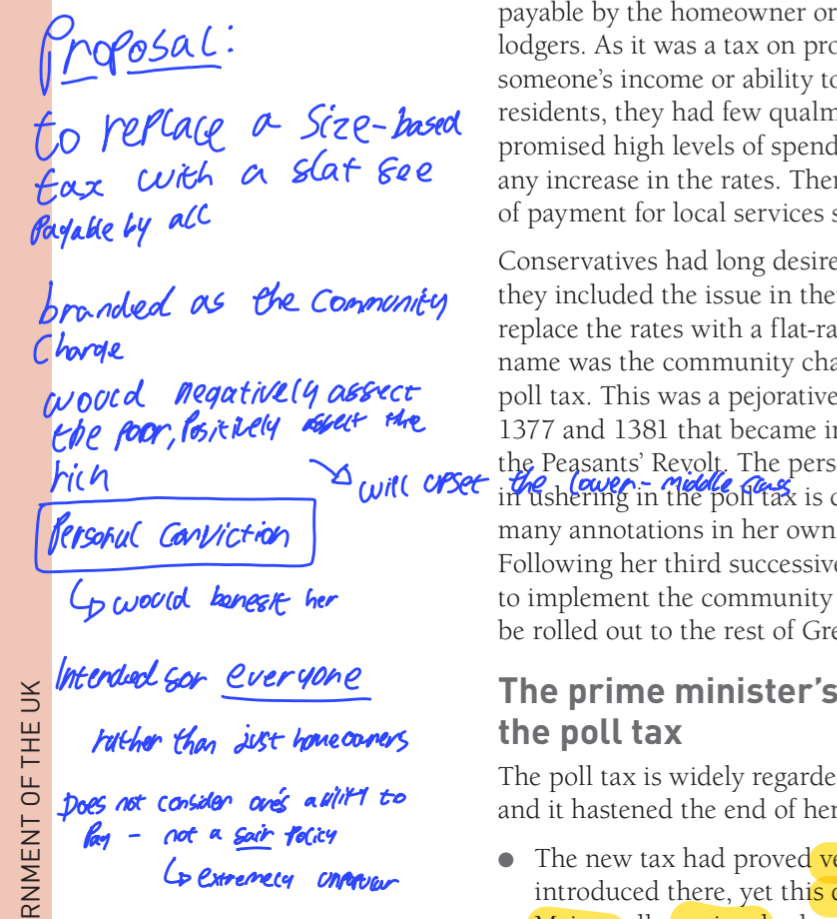
Used this in class (reading)
Tony Blair’s “Iraq War” - 2003
- “What was the role of the Prime Minister in this example?”
- Policy Maker, leader.
- “What successes were there for the government?”
- None - the government failed to learn from the mistakes made and led to the loss of many human lives.
- “What was the role of the Cabinet in this example?”
- Weak, ignored.
- “What failures were there for government?”
- Many - it failed to do proper due diligence and pushed forward.
| Context | Detail |
|---|---|
| Background | The US has requested that the UK assists them in the invasion of Iraq. Tony Blair obliged to do as such. |
| Reason for Policy | (background), US was seen as an ally, Tony Blair wanted to further his relationship with George W. Bush. |
| Opposition to Policy | The evidence for WMDs was patchy at best. |
| Prime Minister Strength How powerful was the Prime Minister? | Tony Blair was not forced out of office, but even re-elected after the war. |
| Cabinet Strength How powerful was the Cabinet? | The Cabinet was effectively ignored. |
Book Annotations

Comparison
| Poll Tax (1990) | Iraq (2003) | |
|---|---|---|
| Differences | Similarities | Differences |
| Resulted in riots | Poorly received by the public | Only large protests |
| Led to Margaret Thatcher’s resignation | Harmed Prime Minister reputation | Tony Blair was still re-elected with a loss of 5% of seats |
| Made major imbalance between the poor and rich | Forced through/delivered policy | Led to the loss of many lives |
| Ignore Cabinets but was still given information and kept professional | Exercising Prime Minister Power | Intentionally ignored and lied to Cabinet |
| Cabinet regained power after Margaret Thatcher’s resignation | Manipulated government agencies via. political pressure to provide more ideal results |
Theresa May’s “Snap Election” - 2017
- “What was the role of the Prime Minister in this example?”
- “What successes were there for the government?”
- “What was the role of the Cabinet in this example?”
- “What failures were there for government?”
| Context | Detail |
|---|---|
| Background | |
| Reason for Policy | |
| Opposition to Policy | |
| Prime Minister Strength How powerful was the Prime Minister? | |
| Cabinet Strength How powerful was the Cabinet? |
David Cameron (2015) promised a referendum of an EU membership. Because he won the election, he delivered this in 2016. 52% voted to leave, 48% voted to remain. This caused Cameron to resign as PM, and Theresa May took over.
Keir Starmer’s “Welfare Reforms” - 2025
- “What was the role of the Prime Minister in this example?”
- “What successes were there for the government?”
- “What was the role of the Cabinet in this example?”
- Supported the decision, it was needed
- “What failures were there for government?”
| Context | Detail |
|---|---|
| Background | Landslide majority, many new backbench MPs |
| Reason for Policy | The benefits spending was extremely costly |
| Opposition to Policy | Backbench MPs - new backbench MPs, rebellious |
| Prime Minister Strength How powerful was the Prime Minister? | Weak - could not push through any concessions |
| Cabinet Strength How powerful was the Cabinet? | Strong - backed Starmer |
-
higher rates of unemployment
-
larger, aging, population
-
Unpopular - particularly due to the Labour party doing it, having previously advocated for benefits