House of Lords
‘The House of Lords performs some important functions in government and does not require radical reform.’ Analyse and evaluate this statement.
| Paragraph | Point | Explain and Example | Analysis | Evaluative Link |
|---|---|---|---|---|
| Expertise | Specialist Scrutiny | Peers often have professional expertise. Example: Lord Winston (medicine) or Baroness Bull (arts) leading debates. | They provide a “cooling effect” on rushed Commons laws, focusing on technical quality over party politics. | Strong support: Their unique expertise is a function the Commons cannot easily replicate. |
| Checks | Executive Check | The Lords acts as a check on “elective dictatorship.” Example: Defeating the government on the Safety of Rwanda Bill (2024). | Without the pressure of re-election, they can challenge the government on human rights and constitutional issues. | Nuanced: Important function, but they are limited by the Parliament Acts (they can only delay, not block). |
| Reform | Democratic Deficit | The Lords is entirely unelected and contains 92 hereditary peers. Example: Concerns over “cronyism” in prime ministerial appointments. | This lack of a mandate means they often lack the “moral authority” to oppose the Commons, leading to calls for an elected chamber. | Against statement: While functions are important, the lack of legitimacy suggests radical reform is still needed. |
“cronyism” is the appointment of friends and associates to positions of authority, without proper regard to their qualifications.
Parliament Effectiveness
‘Parliament does not fulfil its functions of scrutiny/legislation/representation effectively.’ Analyse and evaluate this statement. (June 2023 - extract Q on select committees)
| Paragraph | Point | Explain and Example | Analysis | Evaluative Link |
|---|---|---|---|---|
| Scrutiny | Select Committees | These are cross-party and evidence-based. Example: The Public Accounts Committee uncovering waste in COVID-19 procurement. | Their bipartisan nature allows for deeper scrutiny than the adversarial “theatre” of PMQs. | Counter-point: Effective at finding flaws, but the government can ignore 60% of their recommendations. |
| Legislation | Executive Dominance | Public Bill Committees are used to pass laws. Example: Whips ensure government MPs rarely vote for opposition amendments. | Because the government usually holds a majority, the legislative process often becomes a “rubber stamp” for the PM. | Supports statement: Legislation is the weakest function because the executive holds too much control. |
| Representation | Descriptive Representation | How well Parliament looks like the UK. Example: The 2024 Election produced the most diverse Parliament (record women and ethnic minority MPs). | Better representation increases public trust and ensures a wider range of perspectives are heard in debates. | Against statement: Parliament has become significantly more effective at representation in recent years. |
Backbench Influence
‘Backbench MPs have few ways to influence the government.’ Analyse and evaluate this statement.
| Paragraph | Point | Explain and Example | Analysis | Evaluative Link |
|---|---|---|---|---|
| Voting | Power of Rebellion | Backbenchers can defeat or change bills by voting against their party. Example: Tory rebels forcing a climbdown on onshore wind farm bans (2023). | When a government has a small majority, a handful of backbenchers can effectively hold the PM to ransom. | Against statement: This is their most powerful “hard power” tool, though it depends on the size of the majority. |
| Agenda | Backbench Business Committee (BBC/BBBC) | Allows backbenchers to choose debate topics. Example: Debates on Hillsborough or the EU Referendum were triggered here. | It gives a voice to issues the government would rather ignore, forcing them to respond to public/backbench pressure. | Nuanced: Great for influence and media pressure, but it rarely results in actual law changes. |
| Constraints | The Whips and Careerism | The “Payroll Vote” (ministers/PPSs) must support the gov. Example: Over 140 MPs are on the payroll and cannot rebel without resigning. | Career ambition and the threat of the Whips (losing the party whip) keep most backbenchers in line. | Supports statement: Most MPs prioritise their careers, which significantly limits their independent influence. |
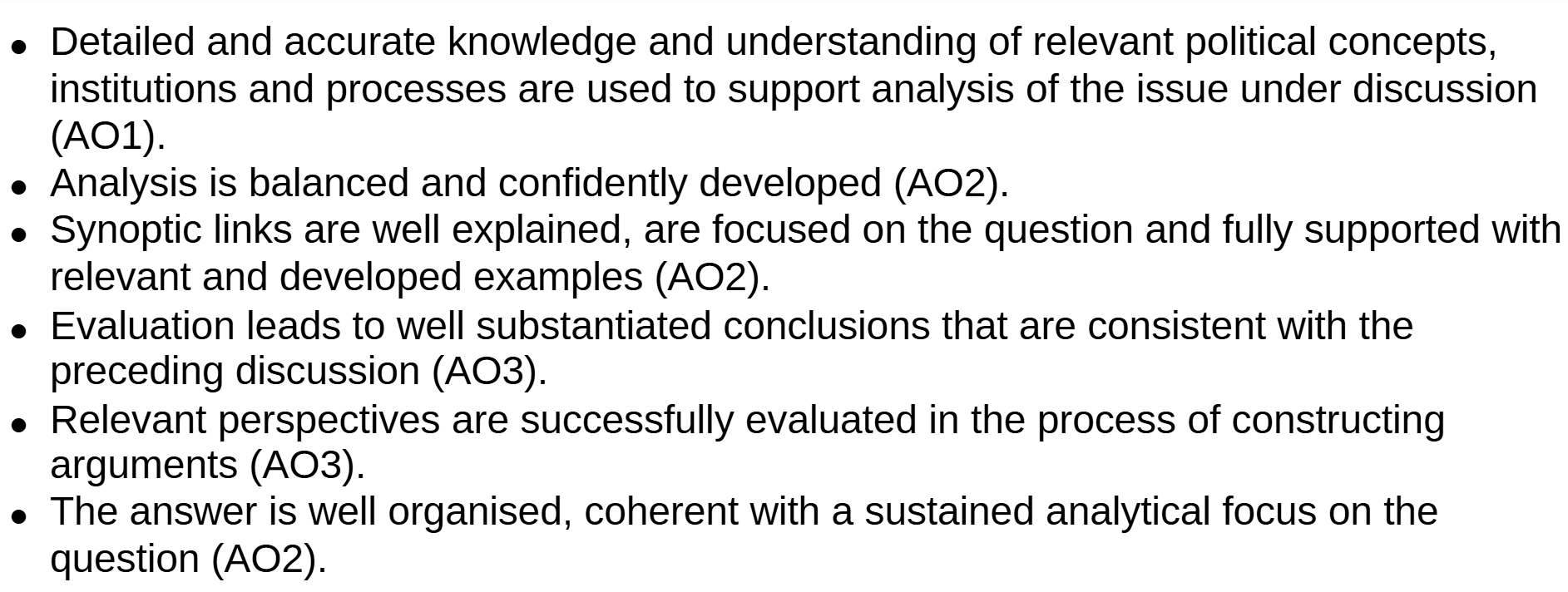
Analyse: To look at significance, ‘why is this important’, ‘what has changed because of this’
AQA definition: students should demonstrate an understanding of the significance, causes, and effects of political ideas, events and concepts, as well as the relationship between them.
Evaluate: To make a reasoned judgement
AQA definition: students should make a reasoned judgement about the strengths and weaknesses of an argument, concept, or theory in a statement or extract