Quite a lot of operations are done for ‘preparedness’.
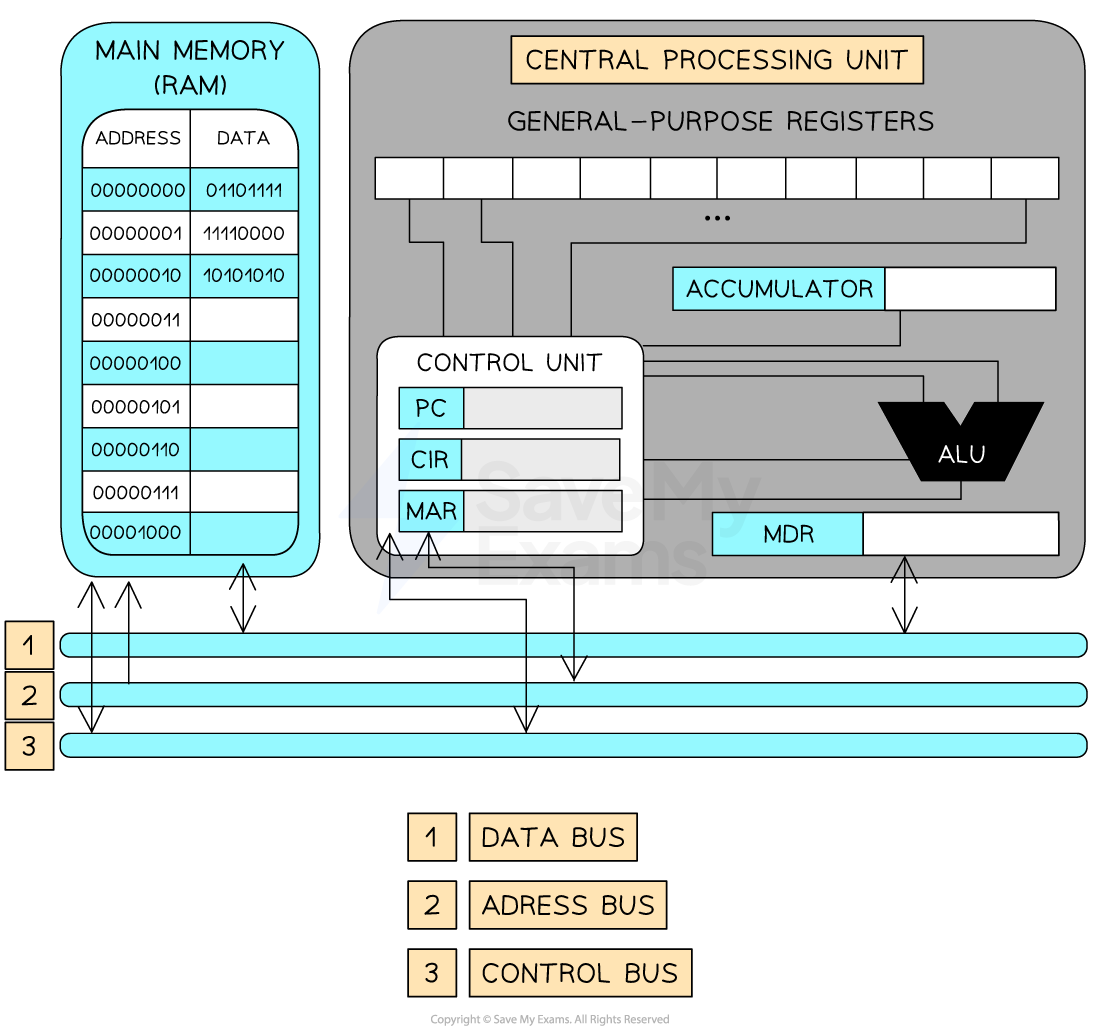
Memory Data Register (MDR)
also known as the Memory Buffer Register (MBR).
- Communicates with the RAM over the data bus, sets and retrieves (MDR ↔ RAM)
- Holds the data (temporarily) which is read from/written to memory
- All data to and from memory must travel down the data bus ad pass through the MDR
Memory Address Register (MAR)
- Communicates with the RAM over the address bus, only sets (MAR → RAM)
- Holds the address of the memory location from which data/an instruction is to be fetched/written to
Program Counter (PC)
- Holds the address of the next instruction to be executed
- Has a very close relationship with the MAR
- At the start of every new fetch-execute-cycle, the address held in the PC is copied to the MAR
- Looks forward
Examples
- The next instruction in a sequence
- The address to jump to if the current instruction is a jump/branch - this is copied from the CIR
Accumulator
- A general purpose register
- Data or control information is often stored here
- A CPU may have many general purpose registers for storing temporary data while instructions or calculations are being carried out
- Typically, the more general purpose registers a processor has, the faster it may operate
- The results of calculations by the ALU may be temporarily stored here
Arithmetic Logic Unit (ALU)
- Performs arithmetic and logical operations on data
- Arithmetic operations on fixed/floating point numbers
- ADD
- SUBTRACT
- MULTIPLY
- DIVIDE
- Bitwise shift operations
- Boolean logic operations
- COMPARISON
- AND
- OR
- NOT
- XOR
- Often uses general purpose registers to temporarily hold the results of calculations such as the accumulator
Current Instruction Register (CIR)
- Holds the current instruction being executed
- The contents of the MDR are copied to the the CIR if it is an instruction
- Contains the opcode and operand(s) of the current instruction
Control Unit (CU)
Imagine it as a traffic warden. 🚦
- Communicates with the RAM over the control bus, only sets (MAR → RAM)
- Coordinates all activities on the CPU
- Accepts the next instruction, decodes it, handles its execution, stores the resulting data back in memory or registers
- Sends memory read and write requests to main memory on the control bus, as well as other command and control signals such as bus requests, bus grants, interrupt requests, etc.
- Makes extensive use of the status registers and clock
Cache
Buses
- Multiple buses are used to work in parallel and for maximum possible speed (avoidance of bottlenecking)
Address Bus
- Carries memory addresses that identify where the data is being read from or written to (uni-directional)
Data Bus
- Carries the binary data that make up the actual information being transmitted around the CPU/computer
Control Bus
- Carries command and control signals to and from every other component of the CPU/computer