Note
These were also used for Grade 9 questions in GCSE.
The Sine Rule and Cosine Rule are used to find unknown sides or angles in non-right-angled triangles.
Sine Rule
The Sine Rule states that in any triangle ABC with sides a, b, and c opposite angles A, B, and C respectively:
This is useful when you only know one pair (side + angle) and another side or angle. Note: this is not limited to order, i.e., .
Example
Cosine Rule
The Cosine Rule states that in any triangle ABC with sides a, b, and c opposite angles A, B, and C respectively:
or rearranged to find the angle:
This is useful when you know two sides and the angle in between
Requirements
- Two sides
- One included angle (“in the middle”)
Example
Question: Show that (4.a.i.).
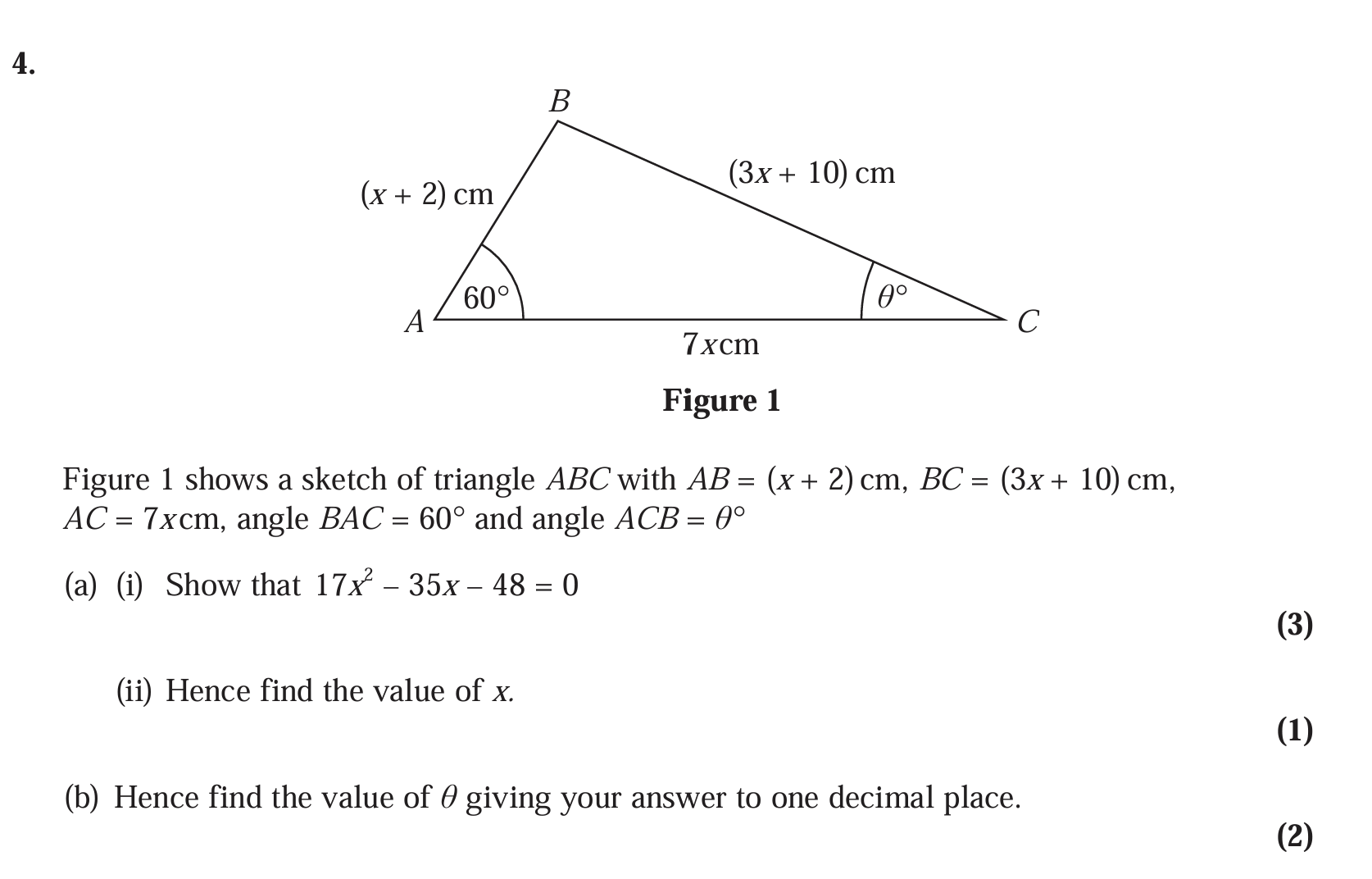
Additional Working-Out
Area Without Perpendicular Height
The area of a triangle can also be calculated using the formula:
where a and b are two sides of the triangle and C is the included angle between those sides.
Requirements
Same as Cosine Rule.
- Two sides
- One included angle (“in the middle”)