See more on the Wikipedia
Thinking
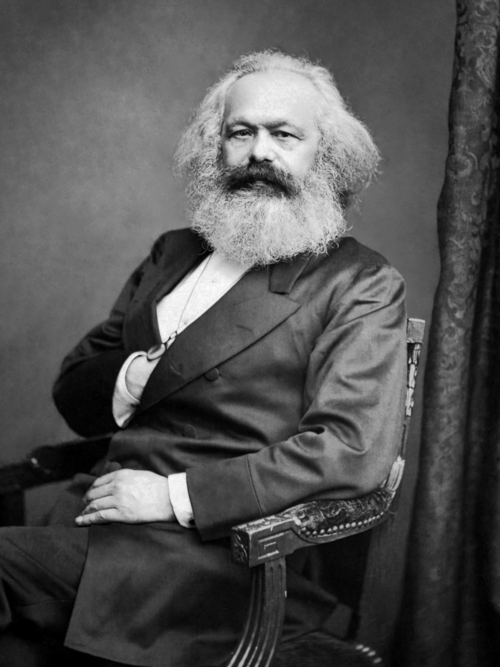
Karl Marx followed the philosophy of Georg Wilhelm Friedrich Hegel (an epistemologist).
He believes in the Hegelian Dialectic:
- Thesis (‘the starting idea’, the way things currently are)
- Antithesis (‘the pushback’, disruption)
- Synthesis (‘the resolution’, combines the best parts of both)
For example, he uses the Hegelian Dialectic for changing between Capitalism and Socialism,
- He sees Capitalism as the thesis
- He sees the revolution of the proletariat as the antithesis
- This is as a result of exploitation and ‘true’ human nature
- He sees Socialism as the synthesis
This is because he sees humans as inevitable to fulfilling their ‘true’ human nature, but does not see humans as being in their ‘true’ human nature whilst in a Capitalist system.
This is because of the difference in human nature. Capitalism sees human nature as exploitative, selfish, and independent, whereas Socialism (Karl Marx) sees human nature as altruistic and collective.
Historical Materialism
Warning
This was partially AI generated.
Historical materialism proposes the idea that humans are constantly evolving and changing. Each stage has a: thesis, antithesis, and synthesis. Each stage proposes change due to class struggle.
Note
Socialists tend to agree with Marx’s criticisms of Capitalism, however, they often tend to disagree with his alternatives to Capitalism, i.e., Communism, and the transition to it.
graph TD
     Flow Direction
    A --> B
    B --> C
    C --> D
    D --> E
    E --> F
    F --> G
    G --> H
    H --> I
Pre-Class Society
Primitive Communism (Pre-History)
- Thesis: Tribal hunter-gatherers share everything. No private property or social classes.
- Antithesis: The invention of farming (agriculture) allows people to settle and create a food surplus.
- Synthesis: Ancient Slave Societies.
Early Class Societies
Slave Society (Antiquity)
- Thesis: Masters own the land and the slaves who do all the work.
- Antithesis: Empires grow too large to manage, leading to slave revolts and economic collapse.
- Synthesis: Agrarian Feudalism.
Feudalism (Middle Ages)
Agrarian Feudalism
- Thesis: Wealth is based entirely on farming. Lords own the land, and Serfs (peasants) are tied to it.
- Antithesis: Trade networks expand, and small market towns begin to grow outside the Lords’ control.
- Synthesis: Feudalism.
Feudalism
- Thesis: A strict hierarchy of Kings, Lords, and Serfs.
- Antithesis: The “Age of Empires” and global trade create a new, wealthy merchant class that lacks political power.
- Synthesis: Industrial Revolution.
Industrial Revolution
- Thesis: Steam power and machinery replace manual farming and traditional crafts.
- Antithesis: Peasants are forced off their land and flood into cities to look for factory work.
- Synthesis: Capitalism.
Capitalism
- Thesis: Factory owners (Bourgeoisie) own the businesses, and workers (Proletariat) work for wages.
- Antithesis: Workers feel exploited by low wages and poor conditions, leading them to unionis
- e and protest.
- Synthesis: Late/Post-Industrial Capitalism.
Information Revolution
Late/Post-Industrial Capitalism
- Thesis: The economy shifts from factories to technology, digital data, and automated services.
- Antithesis: Automation replaces jobs, and wealth concentrates under tech billionaires. This forces displaced and underpaid workers to develop class consciousness (realising they share the same struggle and uniting to fight back), triggering a crisis.
- Synthesis: Socialism.
Post-Capitalism Future
Socialism
Note
Marx sees socialism as a transitional phase.
- Thesis: The working class takes control of the government, factories, and technology to run them for the public good.
- Antithesis: As society learns to share resources evenly, the need for a strict government or police state naturally fades away.
- Synthesis: Communism.
Communism
Note
Out of the historical materialism timeline, this is the most controversial. Not all Socialists agree with it due to various reasons, i.e., holding a dictatorship instead of a democracy.
- The Final Destination: A classless, stateless society. Everyone contributes based on their ability, and everyone receives based on their need. Class conflict ends because private property no longer exists.