Note
This is discussing economic liberalism, (also known as capitalism).
Traits
The traits of economic liberalism follow the ideology of classic liberalism.
- Where rich people have a lot of the money, creating a divide between rich and poor
- Free trade of capital, goods and service - although there may be taxes, freedom to trade still exists
- Mostly consists of privately owned businesses
- Using resources and ingenuity to create profit
- Market should be laisssez-faire (the government does not get involved much/at all)
Definition
implies that nothing restricts what happens, irrespective of the potential consequences Wikipedia Article: Laissez-faire
Critique
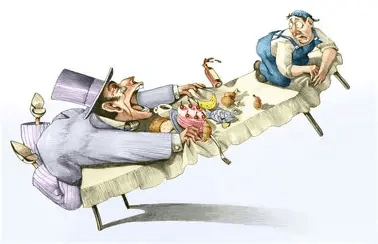
- Top-down economics - the wealth stays at the top
- Large wealth disparity - weak purchasing power for the poor
- Poor people working for his profit
Belief
At the heart of economic liberalism is the underlying belief in the private ownership of property.
Property is seen by liberals as a crucial vehicle for self-realisation and self-determination.
- John Locke emphasised the idea that property is a ‘natural right’ which predates the existence of any state. Later, liberal thinkers like John Stuart Mill also argued that property facilitated individualism - incentivising individual enterprise, reflecting each individuals’ preferences, providing a sense of independence.
- As Locke pointed out, when property is owned by a multitude of individuals, this offers further protection against concentrated power and overbearing rulers who threaten natural rights.
Trickle Down Economics
Although capitalism produces inequality of outcome, liberals defend this on two grounds.
- Economic liberals assert that individual wealth, and individual economic success, will eventually ‘trickle down’ to the majority in society.
- Secondly, they will endorse Mill’s view that unequal outcomes are consistent with a ‘meritocracy’ society - one that encourages individualism and rewards those who have earned their advantages.
Arguing Against
John Rawls argued that liberals should only defend inequality of outcome if it is accompanied by equality of opportunity.
Liberals disagree about which type of capitalism is best for liberty and prosperity. Liberals in the nineteenth century, such as Mill, commended laissez-faire capitalism, whereas liberals in the mid-to-late twentieth century such as Rawls, tended to favour Keynesian capitalism.
Keynesian Capitalism
Keynesian capitalism, based on the work of liberal economist John Maynard Keynes, is a form of capitalism that involves the state directing and managing market forces to ensure steady growth full employment, and therefore greater individual liberty.
The idea is that since everybody has a job, the money is able to flow through the economy. This is a modern liberal view - freedom to.
Examples
Adam Smith
Adam Smith (1723-90) promoted free trade and free market in the late eighteenth century, liberalism has been strongly associated with private enterprise and private ownership of the economy.
State of Nature
The liberal belief in the innate rationality of man does suggest to some people that humanity would be able to manage somewhat effectively without a state to ensure order.
John Locke looked back to pre-civilised society and referred to it as the ‘state of nature’, liberally a society before rules and authority where people followed only natural laws.
Social Contract
The notion of ‘government by consent’, is closely linked to that of ‘government by contract’ - or what Locke and other enlightenment theorists dubbed a social contract.
As we have seen, liberals believe that the ‘natural society’ or ‘state of nature’ is not necessarily undesirable.
Therefore, individuals will only contract out of the ‘state of nature’ and contract into a formal state if they are promised advantages in return. Furthermore, if those advantages stop, citizens are entitled to declare the state illegitimate, cancel the ‘contract’ between the government and the governed and return to the ‘state of nature’.
As the American Declaration of Independence declared in 1776, when a government becomes tyrannical, ‘it is the Right of the People to alter or abolish it’.
Arguing Against
- You can’t really leave the social contract. At most you can leave the country.
Liberal States
Liberal states (unlike most socialist states) are far less concerned about the equality of outcome but rather more concerned with protecting your liberty & rights.
How is power dispersed?
- A formal ‘separation of powers’ between the executive, legislature, and judiciary.
- A separation of powers within the legislature itself, producing a ‘bicameral’ (two-house) legislature.
- A Bill of Rights, overriding the ‘transient’ policies of governments.
- A Supreme Court, whose decisions may override those of elected governments.
- A federal state, whereby many of the state’s functions are delegated to various regional governments.